Why Greece Is the Mediterranean's Original Table
The Diet the World Studies, at the Source
The Mediterranean diet the world's cardiologists keep prescribing was not invented in a lab — it was observed, mid-century, on Crete: olive oil consumed like a beverage, mountain greens and cheeses, fish, pulses, wine in company. That original table is still set daily across Greece, and it eats far better than its clichés: Athens layers a serious street-food canon over the great Varvakios market; Thessaloniki — the Balkans' food capital — runs on bougatsa mornings and Ottoman-depth flavors; Crete presses oil from groves older than most countries; and Santorini grows one of the world's great white wines in volcanic ash, on vines woven into baskets against the wind.
The pleasure — and the problem — is that none of it is in one place, and in Greece the map itself changes shape: some experiences belong to cities (the market walks, the street food, the cooking classes), while others belong to whole islands — you don't taste olive oil in a town, you taste it across Crete; you don't tour a Santorini suburb's wineries, you tour Santorini's. This guide is organized the way Greeks actually think about it: by city where the city is the unit, by island where the island is.
Below, eight categories of Greek culinary experience — grouped into tours, hands-on classes, and tastings — each comparing the best places to book it. We don't sell anything on this page. We point you to the right category and place, and let you book on the page that fits your trip.
Choose Your Greek Food Experience
Eight Ways to Taste Greece
Grouped into guided tours, hands-on classes, and tastings. Each category page compares the best cities and islands to book it in.
Tours
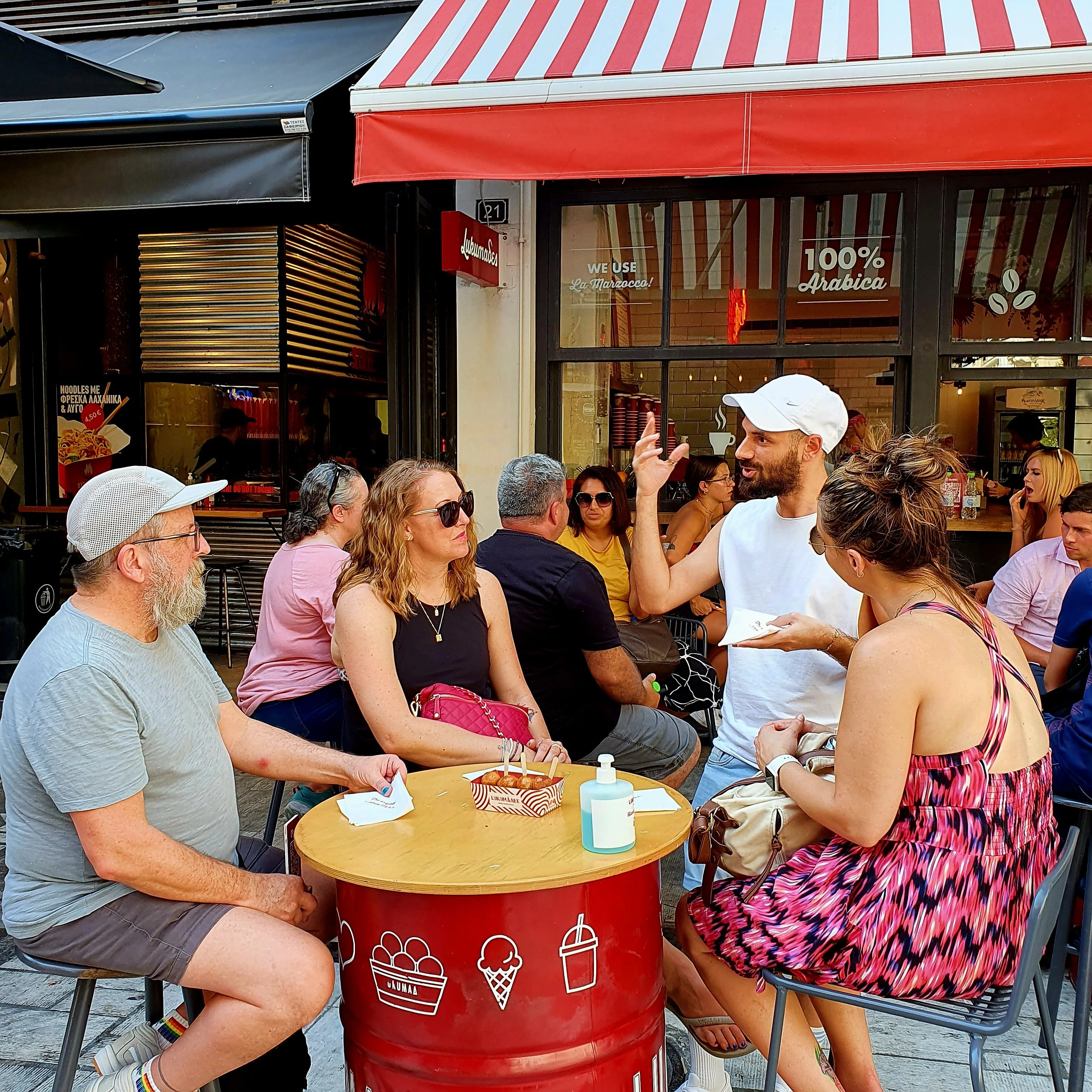
Agoras, Tavernas & Tasting Walks
Eat your way through Athens' market district, Thessaloniki's Ottoman-depth food streets or Chania's old town with a local guide. The broadest way into a place — markets, history, and six-plus tastings on foot.
Souvlaki, Koulouri & Bougatsa
Greece's hand-held canon eaten stand by stand — dawn koulouri carts, the eternal souvlaki arguments, and the salted-caramel joy of finding the right stand at midnight.
Inside the Agora
Varvakios at full volume and Thessaloniki's Kapani and Modiano — guided walks through the agoras that never stopped trading, tastings included.
Classes
Tastings
The World's Oldest Groves
Crete is the deep end of olive oil on earth — named thousand-year trees, working mills, and tastings that recalibrate every bottle you buy after. Athens compresses the education into an afternoon.
The Anise Hour
The ouzeri ritual done properly — the cloud in the glass, meze that keep arriving, and Crete's raki poured unbidden at the end of every meal. Guided tastings decode styles and etiquette.
Volcanic Whites & Ancient Grapes
Santorini's assyrtiko grows in ash on ungrafted vines woven into wind-proof baskets; Crete resurrects grapes the phylloxera never met. Tastings are generous and the caldera views unfair.
Beyond Feta
Greeks are among the world's biggest cheese eaters — barrel-brined PDO feta, Crete's graviera wheels, warm mizithra and saganaki doing what halloumi wishes it could.
Where to Book
Greece's Six Great Food Destinations
Each links to its strongest culinary experience — start here if you already know your destination. Going somewhere else? Browse all seven cities & islands →
The Capital's Table
Varvakios market at full cry, souvlaki arguments settled nightly, and every regional kitchen keeping an embassy. Start with a guided market-and-street walk.
Athens Food Tour →The Original Mediterranean Diet
Groves with named ancient trees, family mills, mountain cheeses and raki at every parting — the island the nutritionists studied, tasted at the source.
Crete Olive Oil Tour →Wine from the Volcano
Assyrtiko grown in ash on basket-trained vines older than phylloxera, tasted on a caldera rim at sunset — one of the world's singular wine experiences.
Santorini Wine Tour →The Balkans' Food Capital
Bougatsa mornings, Kapani market depths, and an Ottoman-Jewish-Greek food history you can read stall by stall.
Thessaloniki Food Tour →Crete's Old-Town Kitchen
The Venetian harbor, the 1913 cross-shaped market hall, and western Crete's larder — the island's most walkable food town.
Chania Food Tour →The Working Capital of Crete
Central market lanes, wine country at the city's back, and the least touristic food scene on the island's north coast.
Heraklion Food Tour →Food Tour vs Cooking Class vs Tasting
Which Is Right for You?
Book a food tour if you want to taste widely and walk a real neighborhood — the agora, the tavernas, the bakery counters, with someone who knows which queue is worth joining. It's the better first day in a new city. If your appetite is specific, narrow it: a street food tour works the souvlaki-and-bougatsa canon, a market tour stays inside the agora where everything begins.
Book a cooking class if you want to take something home — the phyllo technique, the recipes, the confidence to attempt moussaka for people you love. Cretan farm classes are the deepest version: the garden, the oil, the wood oven, the long table.
Still deciding among the tastings? Olive oil on Crete is this site's most distinctive experience — the education that changes every future purchase; an ouzo-and-meze evening is Greece's aperitif culture done properly; a wine tour reaches Santorini's volcanic vineyards and Crete's revival cellars; and a cheese tasting proves the country's dairy goes far beyond the f-word.
How to Choose
Three Questions to Find Your Experience
Do you want to cook, taste, or explore?
Hands-on → a cooking class. Taste with a sense of place → olive oil, ouzo, wine or cheese. Eat and walk → a food, street food or market tour.
City or island?
Athens and Thessaloniki are the city-format experiences. Crete and Santorini work at island scale — the wine, oil and cheese pages compare whole-island experiences, while Chania, Heraklion and Rethymno hold the town-level walks.
When are you going?
May–October is island season (Santorini sunset tastings book out first); Athens and Thessaloniki eat well year-round; late October–December is the olive harvest — the single best time for Crete's mills; and Greek Easter transforms every table it touches.
Greek Food Experiences — FAQ
What travelers ask before booking a food experience in Greece.
It depends what you're after. Athens has the deepest supply of everything — market walks, street food, cooking classes, tastings; Thessaloniki is the connoisseur's pick, the Balkans' food capital; Crete is the island the Mediterranean-diet researchers actually studied — olive oil, cheese and farm cooking at the source; Santorini pairs volcanic wines with caldera views. Our city and island pages compare the top-rated experience in each.
We organize experiences the way Greeks think about them: food tours, markets and cooking classes belong to cities (Athens, Chania, Heraklion), while wine, olive oil and cheese belong to whole islands — you tour Crete's groves and Santorini's wineries, not a single town's. Island pages compare experiences from across the island.
No — the experiences we compare run in English. The guide handles the ordering and market conversations, and cooking classes are taught in English with recipes to take home.
Guided food and market tours typically run $50–$90 per person including tastings; hands-on cooking classes $70–$150 (Cretan farm classes with lunch at the upper end); olive oil and ouzo tastings $30–$80; Santorini wine tours $120–$200 with transport and sunset slots. Each page lists current prices.
The deepest version of Greek food travel: you cook in a village or farm kitchen — garden vegetables, the family's own olive oil, often a wood oven — and sit down to a long table afterwards. Most run 4–6 hours with generous wine, and many include a grove or dairy visit. It's the Mediterranean diet as a lived afternoon, not a lecture.
Charmingly, yes: ouzo arrives with ice and water (the louche cloud is the point), always with meze, and is sipped across an unhurried hour. On Crete the same role belongs to tsikoudia (raki), poured on the house at the end of nearly every meal. A guided tasting teaches the styles and the etiquette in one evening.
May–June and September–October are ideal — island season without August's crowds and heat. Late October through December is the olive harvest, the single best time to visit Crete's mills. Athens and Thessaloniki eat well year-round, and Greek Easter (spring, date shifts yearly) is the great festive table if your trip can catch it.
Greece is one of Europe's easiest countries for vegetarians — the fasting-food tradition (ladera: vegetables cooked in olive oil, pulses, greens) means meat-free depth on every menu. Flag dietary needs at booking; cooking classes are the most flexible of all.
Athens for breadth — every region's kitchen plus the Varvakios market and the ancient sites between meals. Thessaloniki for depth — bougatsa mornings, the Kapani and Modiano markets, and an Ottoman-Jewish-Greek food history the city wears openly. They're a 4–5 hour train apart; committed eaters do both.
A few days to a week is enough most of the year. In July–August, and for Santorini's sunset wine slots any time in season, book 1–2 weeks ahead. Most tours have free cancellation, so booking early is low-risk.
Still have questions? Email us at info@greece-food-tour.com